The 3 C’s of Cognitive Behavioral Therapy for Procrastination
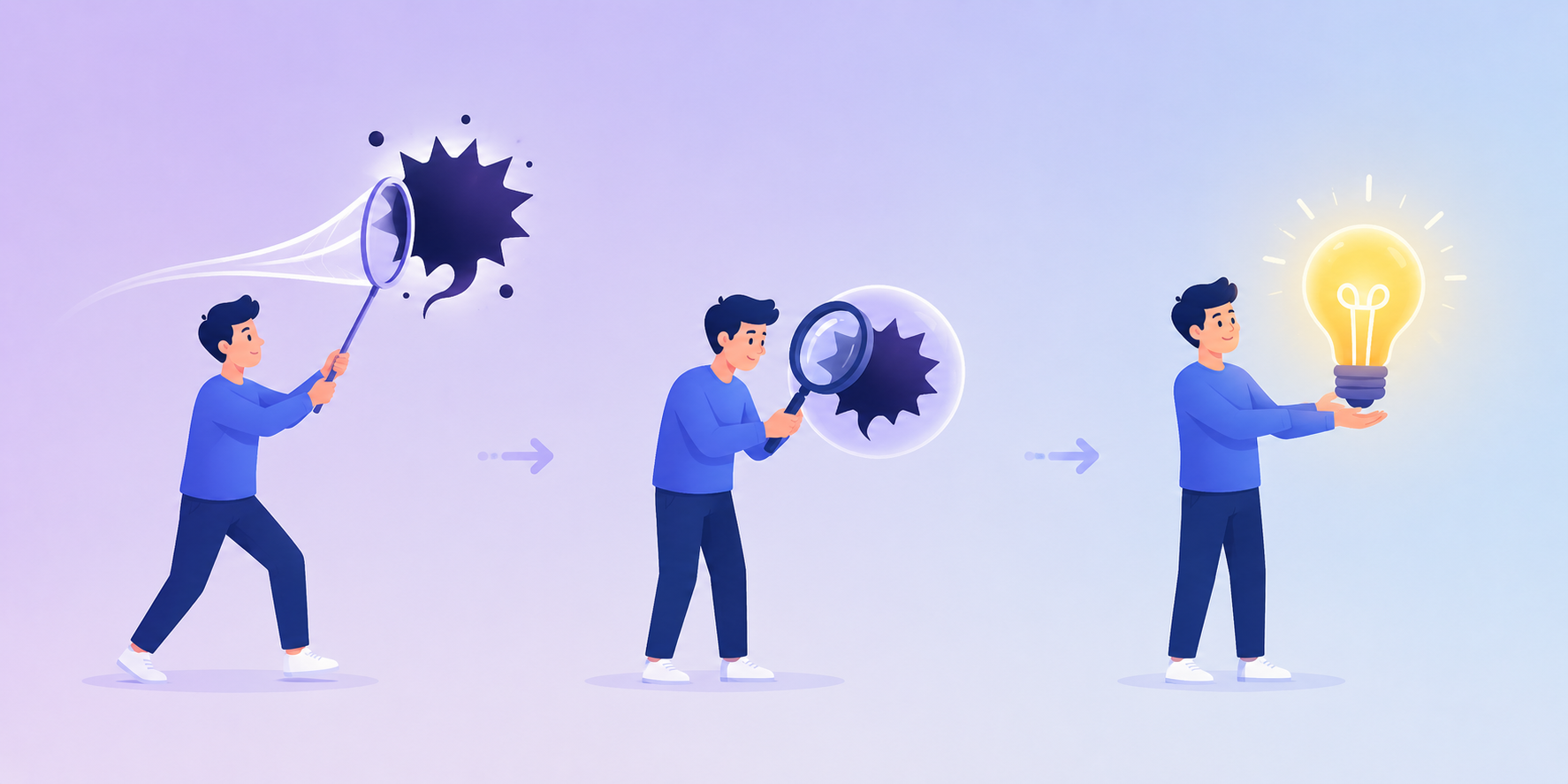
Thesis: Procrastination is driven by negative automatic thoughts (e.g., "I'm going to fail," "This is too hard"). The CBT technique of the "3 C's" helps individuals Catch, Check, and Change these destructive mental loops. Key takeaways: How to step out of autopilot; restructuring cognitive dissonance; replacing emotional false alarms with objective truths.
Imagine a psychotherapist who specializes in career counseling working with two different clients. Both clients need to update their resumes to apply for a major promotion, and both are terrified of doing it.
Client A, let's call him Mark, sits down at his laptop. Immediately, a quiet voice in his head whispers, "You don't have enough experience. They are going to laugh at your application. This is too hard." Mark feels a sudden spike of anxiety. To make the bad feeling go away, he closes his laptop and spends three hours reorganizing his kitchen pantry to feel productive.
Client B, Chloe, hears the exact same voice in her head when she opens her laptop. But instead of running away, she pauses. She notices the thought, questions if it is actually true, and gently corrects it. She reminds herself that she meets most of the job requirements and that her current boss recommended her for the role. Her anxiety drops, and she finishes her resume.
Why did Mark fail while Chloe succeeded? Chloe utilized a specific trick to outsmart her own mind.
What is CBT for Procrastination?
For decades, we have been told that we just need more discipline. But modern psychology proves that our actions are dictated by our inner dialogue. Cognitive Behavioral Therapy (CBT) operates on a simple, powerful rule: your thoughts shape your beliefs, your beliefs influence your behaviors, and this chain extends directly to your emotions.
When it comes to our daily tasks, CBT for procrastination is a highly effective, present-focused treatment. Instead of digging into your childhood, a behavior therapist using CBT helps you identify the negative thought patterns driving your avoidance, challenge their validity, and replace them with realistic thoughts.
How Do Negative Automatic Thoughts Cause Procrastination?
To understand why a simple thought can completely paralyze you, we have to look at the neuroscience of the brain.
When you sit down to do something difficult, you might experience negative automatic thoughts like "I'm going to fail" or "I'm never going to finish this". Your brain's emotional fear center, the amygdala, perceives these negative thoughts as an actual psychological threat. To protect you from this "danger," the amygdala hijacks your brain and overrides your prefrontal cortex—the logical, rational part of your brain responsible for planning and self-control.
Your brain screams at you to find immediate relief, so you run away to do something easy and pleasurable, like scrolling on your phone. However, avoiding the task creates cognitive dissonance—a highly uncomfortable mental state where your actions (avoiding work) conflict with your beliefs (knowing you need to work). To fix this painful dissonance, your brain makes up excuses to justify your procrastination, trivializing the task or telling you that you will simply "feel more like it tomorrow". You are reacting to an emotional false alarm.
What are the 3 C's of Cognitive Behavioral Therapy?
To beat this cycle, you have to intercept the false alarm before your amygdala forces you to run away. Cognitive behavioral therapy procrastination treatments rely heavily on a highly practical framework known as the "3 C's".Here is how you can use the 3 C's to step out of autopilot:
1. CATCH (Step out of autopilot) Many people go through their day on complete autopilot, totally unaware of the constant stream of negative self-talk running through their minds. The first step is simply becoming aware of these unhelpful thoughts as they occur. When you feel the urge to avoid a task, pause and Catch the thought. Say to yourself: "Aha! There is the 'I can't do this' story again."
2. CHECK (Analyze the cognitive dissonance) Once you've caught the negative thought, you must Check its validity. Put the thought on trial. Ask yourself: Is this thought based on actual facts, or just my current feelings? What actual evidence do I have that I am going to fail? Would I ever say this thought out loud to a friend?
3. CHANGE (Replace with objective truths) After checking the facts, you must Change the thought by replacing it with a more balanced, realistic alternative. This is not about forcing toxic positivity or faking happiness; it is about finding the objective truth.
How to Stop Procrastination Using the 3 C's
If you want to know how to stop procrastination, you have to practice this mental rewiring every day. Here are a few overcoming procrastination tips and procrastination techniques using the 3 C's to tackle the most common mental blocks:
The Perfectionist Block:
Catch: "I can't start this because it won't be perfect."
Check: "Is it really true that my first attempt has to be flawless? Has anyone ever created a perfect first draft?"
Change: "I give myself permission to do a terrible job on the first try. Done is better than perfect."
The Overwhelm Block:
Catch: "This project is massive, I am never going to finish."
Check: "Do I actually have to finish the entire project today, or just a small part of it?"
Change: "I do not have to finish this today. I only have to work on it for five minutes."
The Motivation Block:
Catch: "I don't feel like doing this right now. I will do it tomorrow when I am in the mood."
Check: "Is there any actual proof I will magically want to do this tomorrow? Do I really need to be in the mood to do my chores?"
Change: "I don't feel like doing this, but my internal state doesn't need to match my intention in order for me to act. I can do this whether I feel like it or not."
The next time you feel the urge to delay, remember that your brain is just trying to protect you from a threat that doesn't actually exist. Catch the thought, check the facts, change the narrative, and you will finally put yourself back in the driver's seat of your own life.